Saturday, 8 June 2013

BUTTERFLY NEBULA- Beauty at its peak

The Butterfly Nebula

The bright clusters and nebulae of planet Earth's night sky are often named for flowers or insects. Though its wingspan covers over 3 light-years, NGC 6302 is no exception. With an estimated surface temperature of about 250,000 degrees C, the dying central star of this particular planetary nebula has become exceptionally hot, shining brightly in ultraviolet light but hidden from direct view by a dense torus of dust.

This sharp and colorful close-up of the dying star's nebula was recorded in 2009 by the Hubble Space Telescope's Wide Field Camera 3, installed during the final shuttle servicing mission. Cutting across a bright cavity of ionized gas, the dust torus surrounding the central star is near the center of this view, almost edge-on to the line-of-sight. Molecular hydrogen has been detected in the hot star's dusty cosmic shroud. NGC 6302 lies about 4,000 light-years away in the arachnologically correct constellation of the Scorpion (Scorpius).

Image Credit: NASA/ESA/Hubble

Wikipedia in space. Asteroid named after Wikipedia

Main belt asteroid Number 274301 was officially named after the online encyclopedia, Wikipedia on January 31, 2013. Of course, the name was changed because Main Belt asteroid No. 274301 didn't roll quite off the tongue like Wikipedia does.
However, the official press release from the Andrushivka Astronomical Observatory in Ukraine, the same observatory that found the asteroid belt in 2008, stated that they chose the name Wikipedia to honor a website that can educate people around the world for free.
Not only is Wikipedia a free database of information, it is also one of the most visited websites in the world and can be translated into 270 different languages. All of this was achieved within 11 years after Wikipedia launched!

Read more at http://www.omg-facts.com/category/7/Science#QkTd8rwOyrdM3oFc.99 

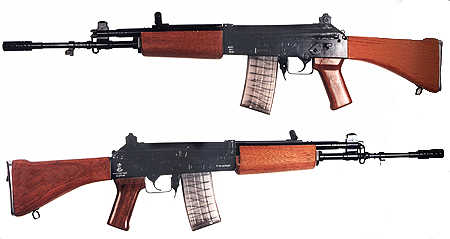
INSAS Famous Indian Assault Rifle

Caliber: 5.56x45 mm NATO
Action: Gas operated, rotating bolt
Overall length: 945 mm with fixed butt; 960 / 750 mm with folding butt
Barrel length: 464 mm
Weight: 3.2 kg empty
Rate of fire: 650 rounds per minute
Magazine capacity: 20 or 30 rounds

Since late 1950s, Indian armed forces were equipped with 7.62mm NATO L1A1 self-loading rifles, which were licensed copies of the famous Belgian  FN FAL rifle. As the 7.62mm self-loading rifles started to become obsolete by the 1980s, India began to develop the INSAS (Indian National Small Arms System), which incorporated features from several popular foreign designs. The INSAS system was originally planned to have three components - a standard rifle, a carbine, and a squad automatic rifle (LMG), all chambered for 5.56 x 45 NATO ammunition. In 1997 the rifle and LMG were ready for mass production, and in 1998 the first units were observed on an Independence Day parade armed with INSAS rifles. The mass introduction of the INSAS rifle was initially delayed by the lack of the domestically made 5.56 mm ammunition and India accordingly bought significant stocks of ammunition from the Israeli IMI company.At the present time at least 300,000 INSAS rifles are in service with the Indian army; some of these have seen action in Indo-Pakistani conflict. The INSAS rifles are made by the Ishapore Rifle Factory.
The INSAS rifle is broadly based on the famous Kalashnikov AK-47 action, but with many modifications. The basic gas-operated action with long stroke gas piston and a rotating bolt, as well as the stamped steel receiver, are generally the same as in modern Kalashnikov rifles. However, the gas system is fitted with a manual gas regulator, similar in design to that found on FN FAL rifles, as well as a gas cutoff. The charging handle has been moved from the bolt carrier to the left side of the forearm; it is similar in position and design to German HK G3 rifle. The selector / safety switch is located at the left side of the receiver, above the pistol grip, and allows for single shots and three round bursts. The rifle is fitted with a side-folding carrying handle, and either a solid or side-folding metal buttstock. Furniture can be made from wood or polymer. Standard magazines are made from semi-translucent polymer and contain 20 rounds. Longer 30-round magazines of similar design are available for the INSAS LMG but can also be used in the rifle. The sights consist of a hooded front, mounted on top of the gas block, and a diopter rear, mounted on the receiver cover. The flash hider is shaped to accept NATO-standard rifle grenades. INSAS rifles can be fitted with AKM-style multipurpose knife-bayonets. For further more info log in to http://world.guns.ru. Thank you